
RC track website sample
Race nights and online entry, without paying for every update
Marq Line Raceway is an RC track website sample. A track’s schedule changes every week, so the site is built around a schedule that keeps itself current, and around racers paying their entry before they arrive.
- Sample
- Marq Line Raceway, RC racing track (seven pages)
- Built from
- Growth template, expanded scope: seven pages
Marq Line Raceway is a fictional business. Every name, address, phone number, price and date on the sample is made up, and its forms and checkouts are demonstrations that send nothing and take no payment.
What an RC track needs from its website
- This week’s racing, first. A racer who drives out on the wrong night doesn’t come back.
- A schedule that is right without someone paying for each change, through a winter of weekly race nights and special events.
- Classes, entry fees and rules that a new racer can read before showing up.
- Passes, memberships and rentals with the prices posted.
- A way to pay the entry ahead and skip the line at the counter.
The features that show it
The schedule, from one list
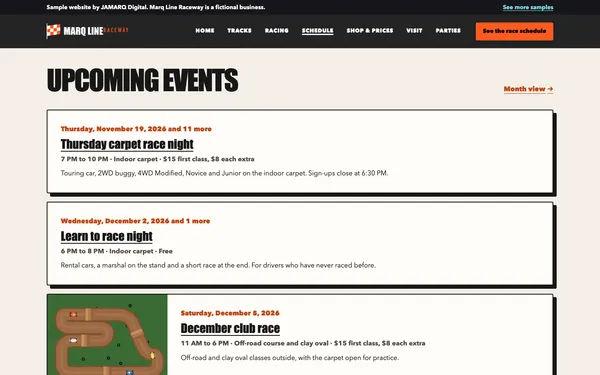
The Schedule page shows every race on the calendar: the Thursday carpet race night each week through February 18, 2027, and special events such as the December club race, the Holiday Enduro, the Winter Indoor Championship and a crawler competition. A month view sits one click away.
A page for every race night
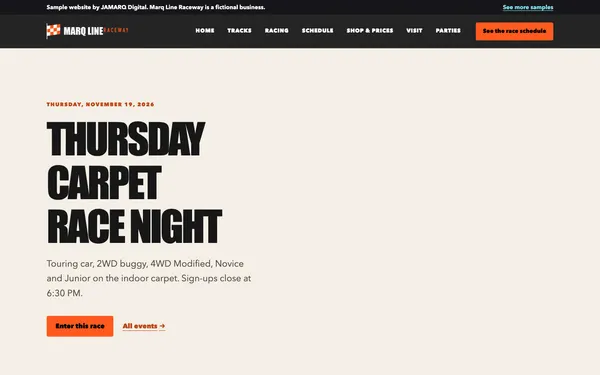
Each race has its own page with the classes that run, when sign-ups close and the entry fee: $15 for the first class and $8 for each extra on a Thursday night. The Enter this race button goes straight to online entry.
Race entry before you arrive
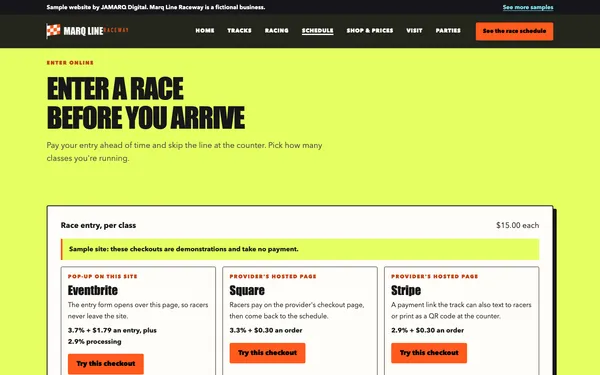
Racers pick how many classes they’re running, up to three at $15 each, and try three checkouts: one that opens over the track’s page (Eventbrite’s style), the provider’s hosted page (Square’s), and a payment link (Stripe’s) the track can also text to racers or print as a QR code at the counter.
Each one shows its fee, and the ticketing and payment fees note compares them. They are demonstrations: no card field, and no payment is taken.
Prices on the wall, and on the site
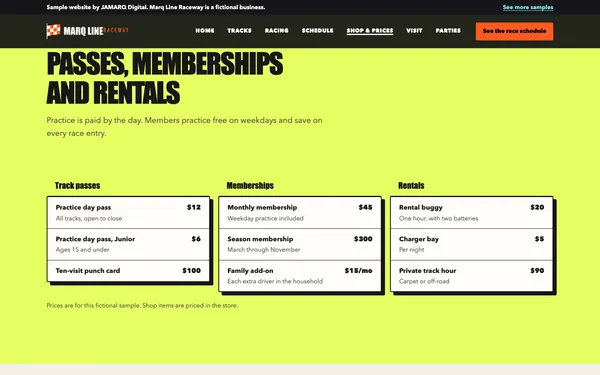
Passes, memberships and rentals are one price list: a $12 practice day pass, a $45 monthly membership, a $20 rental buggy and a $90 private track hour, among others.
Also on the sample
- Three tracks, each with its own drawing: the indoor carpet, a clay oval and an off-road course.
- Eight race classes, from Novice and Junior to Rock Crawler, with the rules a new racer needs.
- A party request form in demonstration mode, with the party options in its own picker.
- A labelled stand-in video where race footage would go.
How it’s built, and what it costs
How updating works. Every race in the sample is one entry in the site’s settings. The site builds the schedule, the race’s own page and the month view from that one entry, so adding a race night is one change, not three. Past races drop off by themselves when the site rebuilds, so nobody pays to delete last Thursday.
For a real track that wants to post races itself, the schedule can come from a Google Calendar the staff already keep, with the site rebuilding on a timer. A race added to the calendar then reaches the site without a change request. Ask about it when we scope the build.
Built from the Growth template, version 1.6.0, with the track’s orange, wordmark and drawings set in the template’s settings file. None of the template’s code was changed.
Growth sites are $1,500 – $2,500. Every website price is on the pricing page.
Related note
Ticketing and payment fees compared →What each provider takes on a small entry fee, from each provider’s own pricing page.