
Case study
Midway Music Hall
Custom Website and Seating System
Midway Music Hall needed a modern, owner-controlled system that could handle live event operations without renting a ticketing platform.
I rebuilt the stack end to end: fast public site, secure admin workspace, interactive seating layouts, reservation workflow, media management, and automated notifications built around day-to-day venue operations.
Proof of adoption arrived immediately: the first reserved seating request hit the new system two days after launch.
Stack: React, PHP, MySQL, Tailwind, CloudflareLaunch: December 2025
Project Overview
Midway Music Hall needed more than a visual refresh. The venue needed a dependable, long-term system that reflected how shows are actually scheduled, how reserved seating is handled in practice, and how staff communicate with customers day to day, without renting a third-party ticketing platform or paying recurring SaaS fees.
I delivered a fully custom platform: a public-facing website plus a secure admin workspace built specifically for venue operations. The system supports event scheduling, recurring series management, interactive seating layouts, reservation requests, media handling, and automated notifications, all validated under live use.
This was an operational system built around the venue’s workflow, not a template refresh.
Client
Midway Music Hall, Midway NC
Project Type
Full website rebuild and custom venue operations system
Timeline
November to December 2025
Launch
December 1, 2025
Screenshots
What The System Handles
Documentation covering performance results, public pages, and mobile parity. Authenticated admin workflows are summarized below but not pictured publicly so client records stay private.
Lighthouse / PageSpeed evidence
Measured against midwaymusichall.net on 3 June 2026. Scores vary between runs; treat them as a range rather than a fixed figure.
Desktop
FCP
0.4 s
LCP
0.9 s
CLS
0
TBT
0 ms
Mobile
FCP
2.3 s
LCP
4.1 s
CLS
0
TBT
10 ms
Before and after the rebuild
Measured 15 December 2025, then again 20 December 2025.
| Category | Desktop | Mobile |
|---|---|---|
| Performance | 85improved to100 | 60improved to93 |
| Accessibility | 69improved to100 | 69improved to100 |
| Best practices | 100improved to100 | 100improved to100 |
| SEO | 92improved to92 | 92improved to92 |
Customer-facing pages that handle event discovery, archives, and related venue content.
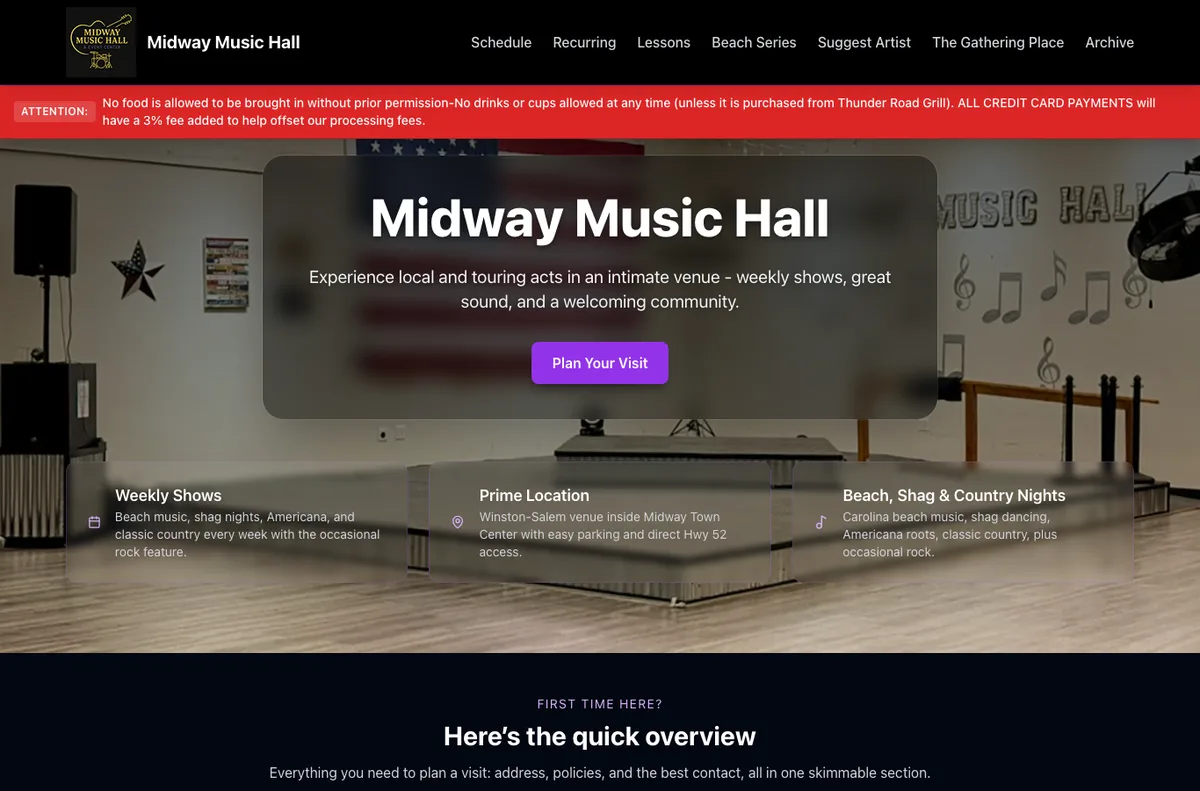
Current live homepage capture showing the event-forward layout, quick venue overview, and upcoming show structure after the latest content updates.
Technical note
Current capture uses the live production homepage and preserves only public event, venue, and navigation information.
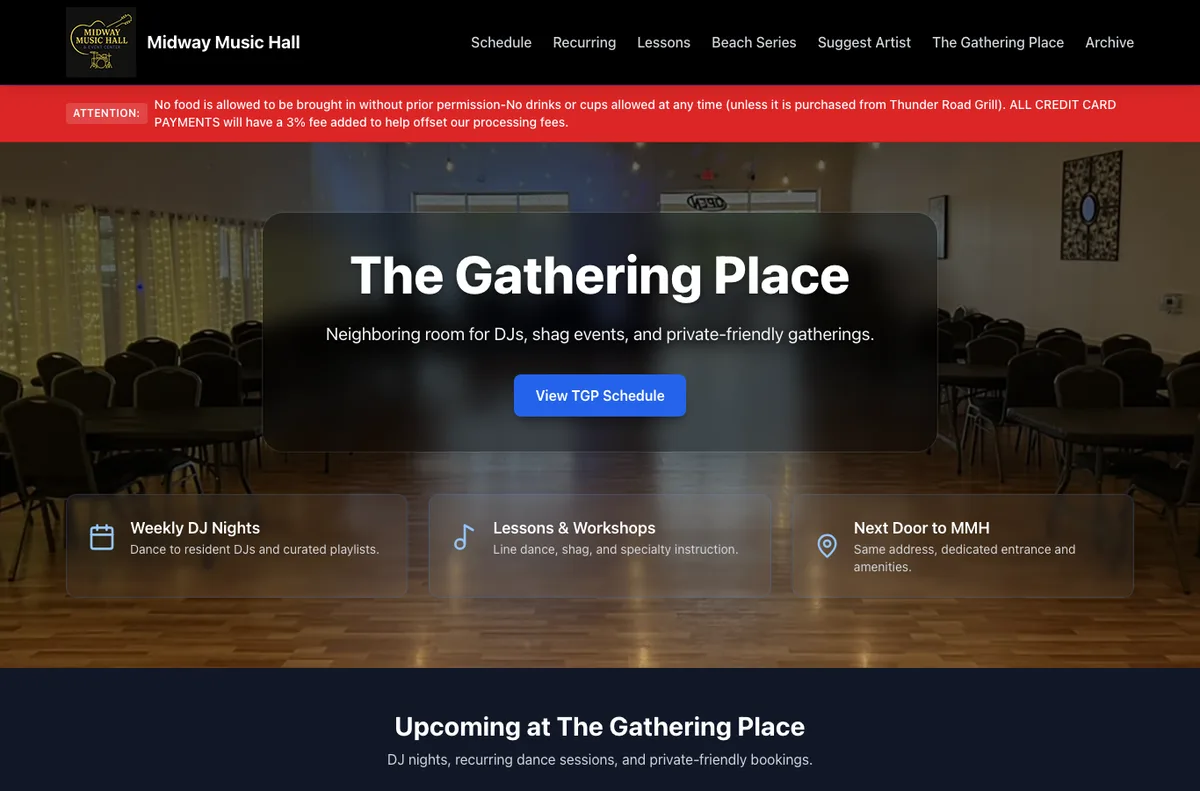
Current live view of The Gathering Place page, preserving the related-venue experience inside the same public system.
Technical note
Current capture uses the live public related-venue route; private admin records and booking data are intentionally not included.
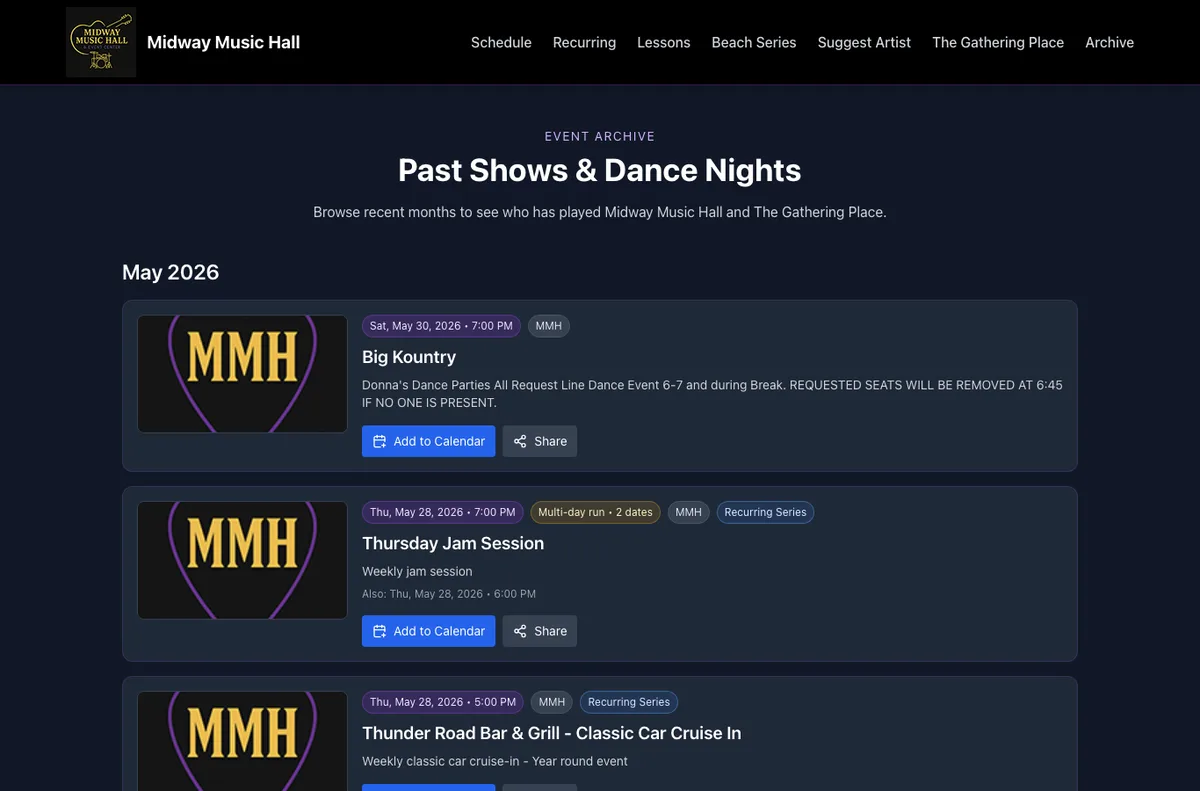
Current live archive view showing how past events remain browseable without cluttering the main upcoming schedule.
Technical note
Archive data is public event history. Administrative audit logs, reservation records, and user tables are excluded from the public case study.

Previous homepage performance and layout before the rebuild, showing limited optimization and accessibility constraints.
Technical note
Legacy layout relied on unoptimized assets and non-deterministic image loading, resulting in inconsistent performance and accessibility scores.

Rebuilt homepage with optimized layout, improved accessibility, and significantly improved performance metrics.
Technical note
Homepage rebuilt as part of the React SPA with deterministic layout, responsive media helpers, and cached CMS defaults to ensure consistent rendering and improved Lighthouse results.

Upcoming event schedule with consistent filtering and clear date handling.
Technical note
Schedule data is served via unauthenticated JSON endpoints with server-side date filtering to avoid client clock drift issues.

Public archive view allowing visitors to browse past events without cluttering current listings.
Technical note
Archive view is driven by shared SQL lifecycle rules so public listings and admin filters remain consistent across upcoming, past, and archived events.

Integrated venue presentation maintaining branding consistency across related spaces.
Technical note
Related venue content shares branding and layout components while remaining independently configurable through CMS settings.
The Challenge
The previous website was informational only. As event volume increased, several operational gaps became increasingly costly:
- •No centralized event management
- •No digital representation of reserved seating
- •Manual handling of seat requests via phone and email
- •No admin interface for staff
- •No audit trail or request history
- •High risk of seat conflicts and human error
- •Limited performance and accessibility safeguards
Staff had to mentally track availability, copy details between systems, and answer the same questions repeatedly. Customers had no clear visibility into seating before reaching out.
Objectives
- •Create a clear, modern public website
- •Centralize event scheduling and visibility
- •Support recurring events without duplication
- •Introduce an intuitive reserved seating request flow
- •Prevent seat conflicts through enforceable logic
- •Protect existing reservations from accidental admin actions
- •Automate staff notifications
- •Provide a secure admin interface for daily operations
- •Optimize performance for shared hosting
- •Establish a clean SEO and accessibility foundation
- •Maintain full ownership of code and data
Approach
I built the system around real venue workflows, not generic ticketing assumptions.
Rather than forcing the venue into a third-party model, the platform mirrors how Midway Music Hall already operates: staff-approved reservations, flexible seating layouts, recurring shows, and human judgment where it matters.
I built guardrails, not just features. The admin tools prevent accidental data loss, protect hours of manual seat entry, and make recovery possible if something ever goes wrong.
Reliability, clarity, and predictability were prioritized over clever automation.
The Solution
Public Website
- •React-based single-page application
- •Mobile-first layout with accessible navigation
- •Event listings with upcoming, recurring, and archived views
- •Event detail pages with optional interactive seating layouts
- •Category-aware displays including recurring series and Beach Bands events
- •Progressive enhancement with static fallbacks for bots and no-JavaScript clients
Custom Seating System
- •Reusable seating layout templates
- •Versioned seating layouts per event
- •Interactive seat selection with availability indicators
- •Time-limited seat holds to prevent conflicts
- •Automatic expiration and release of unconfirmed seats
- •Staff approval, denial, and manual reservation tools
Safety & Recovery Features
- •Seating visibility toggle that hides UI without deleting data
- •Guarded layout changes with explicit admin confirmation
- •Automatic snapshots of reserved, pending, and held seats before any destructive action
- •Admin-accessible snapshot preview and restore tools
- •Guaranteed preservation of customer reservations unless an admin explicitly confirms a change
Recurring Events & Scheduling
- •Series master entries for recurring events
- •Admin-editable recurring metadata including schedule summaries and notes
- •Series masters editable without requiring dates
- •Individual occurrences still enforce full date and time validation
- •Public event cards reflect recurring series metadata consistently
Category-Aware Admin Platform
- •Secure staff login with idle and hard session timeouts
- •Centralized event creation and management
- •Category-aware editor that adapts to event type
- •Recurring events expose recurring controls automatically
- •Seating controls appear only when seating is enabled
- •Category-specific panels appear without affecting unrelated data
- •Validation rules change intelligently based on context
Media & Email Automation
- •Media upload and management system with optimization metadata
- •Automated staff notifications for seat requests and submissions
- •Production-only safeguards to prevent test spam
- •Domain-authenticated delivery via SendGrid
- •Reply-to support for direct staff responses
Technical Stack
- •React 18 with Tailwind CSS
- •PHP 8.1 backend with JSON APIs
- •MySQL database with transactional reservation logic
- •Cloudflare and Apache deployment on shared hosting
Results
Live Validation
- •First live seat request processed two days after launch
- •Automated notifications delivered successfully
- •Seat conflict prevention confirmed in production
- •Recurring event workflows validated by staff
- •Seating guardrails tested without data loss
Performance & Reliability
- •Fast load times in production
- •Stable layouts with no visual shifting
- •Strong desktop and mobile performance
- •Predictable behavior under concurrent seat requests
- •Graceful fallbacks for missing media or partial data
Key Takeaways
- •Custom systems outperform generic platforms when aligned to real workflows
- •Reserved seating requires guardrails, not just interfaces
- •Admin tooling prevents more errors than automation alone
- •Data recovery paths are as important as primary features
- •Ownership eliminates long-term platform risk
Want to see how the seating guardrails work?
Detailed notes on the database, reservation tools, and deployment checks are available on request.